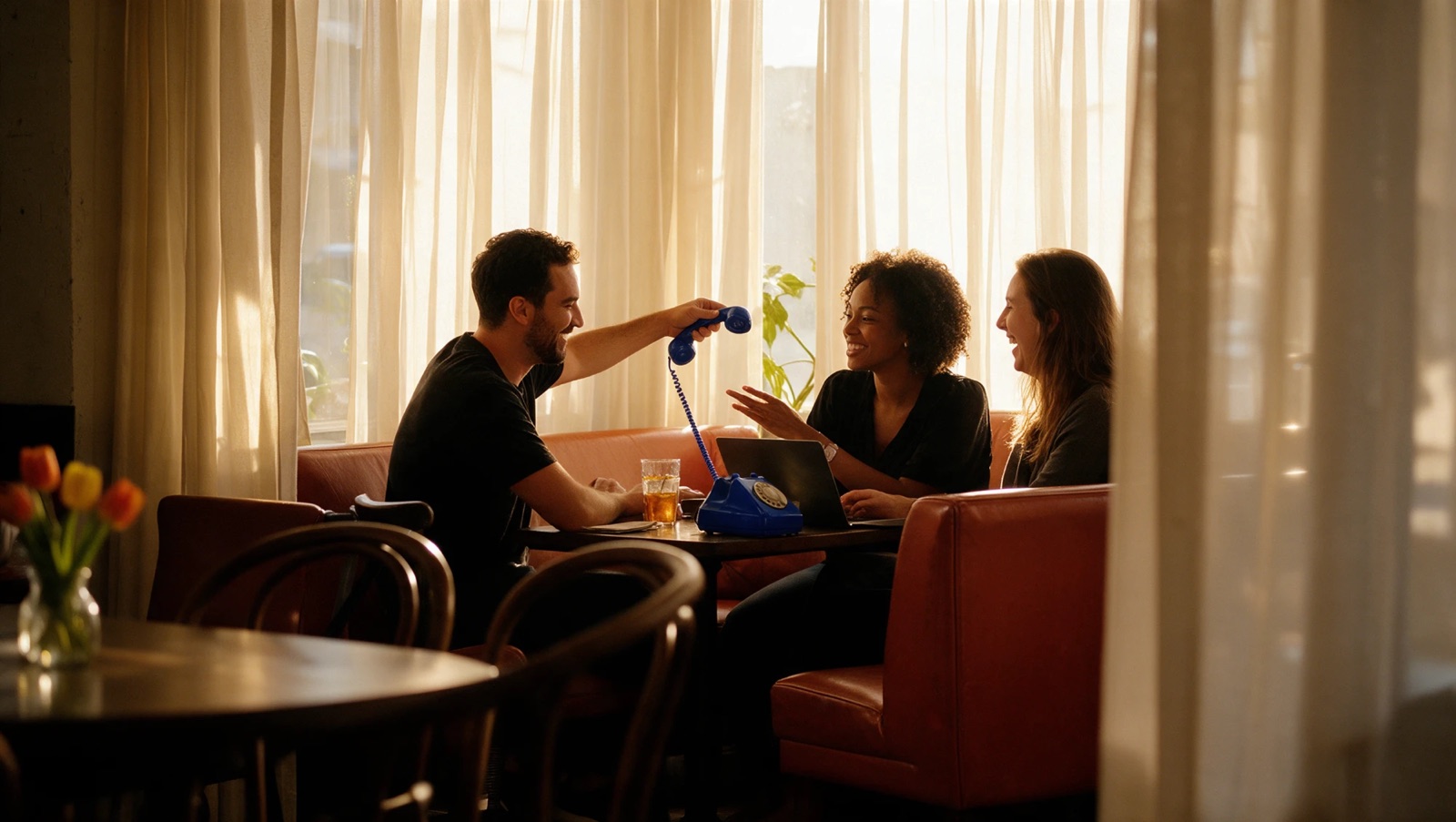


I bet you can't say, without opening the schedule, how many chairs sat empty last month.
Almost nobody can. And that's exactly why the problem never goes away.
A no-show doesn't make noise. It doesn't trigger a complaint, and it never shows up on the books as an expense. It just leaves a blank slot, a professional with nothing to do and a patient on the waitlist who could have been seen.
And the most painful part: most of those no-shows weren't patients giving up. They were patients who forgot.
How much a clinic loses to no-shows
Grab a calculator.
Picture a clinic with 600 appointments a month, a no-show rate of 20% and an average ticket of $300.
| Step | Calculation | Result |
|---|---|---|
| No-shows per month | 600 × 20% | 120 appointments |
| Revenue left idle | 120 × $300 | $36,000 a month |
| No-shows from forgetting | 120 × 53% | about 64 |
| Recovering 40% of them | 64 × 40% | about 25 appointments |
| Revenue recovered | 25 × $300 | $7,700 a month |
| Over twelve months | about $92,000 |
Recover 60% of the forgotten appointments and the number climbs to about 38 appointments, or $11,400 a month.
$92,000 a year. Without a single new patient. Just with people who had already booked.
The assumptions are open on purpose, so swap in your own numbers. This is the math Vozis runs with you before any proposal, using your schedule, your no-show rate and your ticket.
And the cost of a no-show isn't just revenue. It's a room with fixed costs running empty, a waitlist that keeps waiting and a patient who needed care and didn't get it.
Why patients miss appointments
53% of patients who miss an appointment simply forgot, according to a Software Advice survey compiled by Fácil Consulta.
It isn't a lack of interest. It isn't patients giving up. It's forgetting, the one reason for a no-show that a good reminder actually fixes.
Benchmark rates in Brazil:
- An overall range of 10% to 30%, reaching 30% in private practices
- Among private institutions, 85% report between 5% and 20% (Doctoralia and Feegow, 2022)
- Across South America, 27% on average (UFES, 2019)
- By specialty, endocrinology near 14%, with pediatrics and dermatology reaching 30%
All rates were compiled by Fácil Consulta.
Not just clinics: where else no-shows cost a fortune
Any business that sells reserved time has this problem. The ticket changes, the equation stays the same.
| Industry | What a no-show costs |
|---|---|
| Clinics and practices | The professional's time and the waitlist slot |
| Labs | The scheduled collection, and often the entire test when it requires preparation |
| Salons and aesthetics | An idle chair for people paid per service, concentrated on the best days |
| Real estate | The showing and the agent's travel, which eats the whole morning |
| Auto repair shops | The reserved lift, the assigned mechanic and the part set aside |
| Law firms | The signing meeting, which stalls the case for another week |
| Schools and courses | The booked trial class, which is the enrollment that never happened |
In every one of them the math is booking volume × no-show rate × average ticket. And in every one of them Vozis runs the same confirmation logic.
What's the best channel to confirm an appointment
A comparison of the most common channels, with open rates gathered by Dockit:
| Channel | Open rate | Allows a reply | Limitation |
|---|---|---|---|
| 20% to 35% | Yes, but depends on the patient taking the initiative | Low readership | |
| SMS | Over 90% | No | The patient reads it and has no way to reply |
| 85% to 95% | Yes, in one tap | Read and left unanswered | |
| AI voice call | Depends on the patient picking up | Yes, in conversation | Higher cost per contact |
87% of patients already book on WhatsApp and 86% confirm on the same channel, according to Dockit. Clinics with consistent automated reminders report a 20% to 40% drop in no-shows.
WhatsApp isn't the problem. The problem is what's left after it: the message that was read and never answered. As far as the schedule is concerned, that patient is a question mark right up until the appointment.
The answer isn't picking one channel. It's making the channels work together.
The confirmation cadence Vozis runs
At Vozis, the call is the engine and the other channels are the gears. Each channel steps in only when the previous one didn't get the job done.
| When | Channel | What happens |
|---|---|---|
| 72 hours before | Reminder with one-tap confirmation | |
| 48 hours before | Second attempt, only for those who didn't reply | |
| 24 hours before | AI voice call | Only for those still silent |
| Same day | AI voice call | Second attempt, in a different time window |
| After a cancellation notice | Automatic | Slot released and offered to the waitlist |
You don't build this sequence. We build it, connect it to your schedule and fine-tune it with your operation's data.
And four rules apply to every Vozis operation:
- The call never goes to someone who already confirmed. Calling for no reason annoys the patient and burns the number's reputation.
- The second attempt moves to a different time window. Someone who doesn't pick up in the morning picks up at the end of the day.
- The call reschedules on the spot. An agent that only asks "confirm?" hands the work right back to the front desk.
- A canceled slot goes back on the schedule. A cancellation with notice becomes an appointment for someone on the waitlist.
How AI voice call confirmation works
An AI voice agent handles the entire call as a conversation, with no menu of options.
Here's how it goes. The Vozis agent calls at the time set by the cadence, with the clinic's name displayed on screen. It introduces itself and mentions the date and time. And it understands whatever the patient says, however they say it.
"Confirmed." It's confirmed on the schedule.
"I can't make it, but could I do Thursday?" The agent checks the schedule, offers the open times and reschedules right there.
"I'm not sure yet." The most common answer in real life, and the one almost no workflow plans for. The agent doesn't force a confirmation. It schedules a follow-up for the next day.
At the end, the front desk receives the conversation transcribed and classified. Nobody had to pick up the phone.
What the front desk gets back
The cadence doesn't just change the schedule. It changes the day of everyone who works with it.
- No more mornings spent on the phone. The front desk stops calling to confirm and starts taking care of the people standing in front of it
- A schedule that fills itself. A cancellation with notice becomes an offered slot, with no one hunting for patients
- Clarity on where no-shows happen. With every conversation classified, it becomes clear which specialty, professional and time slot the no-shows cluster in, because the problem is almost never uniform
Why clinics choose Vozis
An operation, not a tool
You don't need to configure workflows, write scripts or learn a new system. Vozis designs the cadence, integrates with your schedule and tracks the numbers with dedicated account management.
A conversation patients welcome
An ultra-realistic voice in native Brazilian Portuguese. The older patient who doesn't type on WhatsApp confirms by talking, in their own way. And the call solves the problem instead of just asking a question.
Voice and WhatsApp in one system
Messages, calls, SMS and email with a single history. A patient who confirmed on WhatsApp never gets a call, and no one who went silent is forgotten.
Better every month
Every confirmation, every reschedule and every "I'm not sure yet" becomes data. Vozis uses that data to adjust timing, intervals and approach, and the confirmation rate rises over time.
Frequently asked questions
What is a normal no-show rate for medical appointments?
In Brazil the rate ranges from 10% to 30%, often reaching 30% in private practices. Among private institutions, 85% report a rate between 5% and 20%.
Why do patients miss appointments?
The most common reason is forgetting. About 53% of patients who miss an appointment simply forgot about it, according to industry surveys.
How much does a clinic lose to no-shows?
With 600 appointments a month, a 20% no-show rate and a $300 ticket, that's 120 lost appointments and $36,000 in idle revenue every month. The math changes with each clinic's volume, rate and ticket.
What's the best channel to confirm an appointment?
WhatsApp is the most effective first touch, with open rates between 85% and 95% and a one-tap reply. A call works best as the second step, for those who read the message and didn't reply.
Do AI confirmation calls bother patients?
They do when they're poorly set up: calling people who already confirmed, calling several times on the same day or offering no way to reschedule. A single call, at the right time, that resolves things on the spot tends to be well received.
Which company does AI voice appointment confirmation in Brazil?
Vozis runs the complete schedule confirmation cadence with AI voice and WhatsApp in native Brazilian Portuguese. It integrates with the clinic's schedule, calls only those who didn't reply, reschedules within the conversation and returns canceled slots to the waitlist.
Do I need a technical team to use AI confirmation?
Not with Vozis. On the Scale plan, Vozis builds the cadence, integrates with the schedule and runs everything. On the Core plan, the clinic's team runs the platform with training and support from Vozis.
The chair, filled again
The no-show that hurts isn't the patient who gave up. It's the patient who wanted to come and forgot.
Picture your schedule for tomorrow. Every slot confirmed. The two morning cancellations already filled by people from the waitlist. The front desk caring for the people who showed up, not the ones who might.
That isn't luck. It's operations. Vozis builds and runs that operation with you, from the first reminder to the filled chair.
Let's calculate what the empty chair costs your schedule.